Consciousness and Culture by Porte Joel
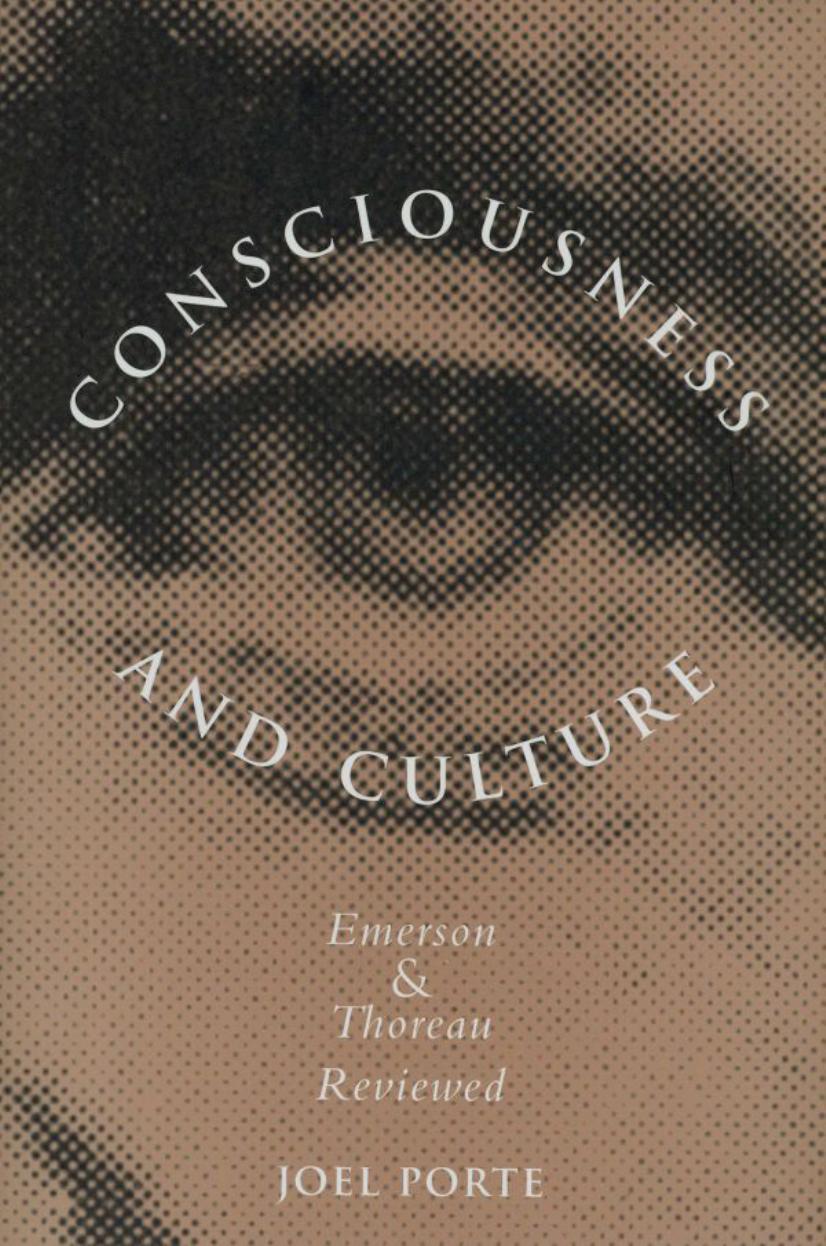
Author:Porte, Joel.
Language: eng
Format: epub, pdf
Publisher: Yale University Press
Published: 2004-07-14T16:00:00+00:00
5. EMERSON’S “FRANCE, OR URBANITY”
A list of French visitors who comment on life in America from the late eighteenth century to the late nineteenth century contains some very distinguished names: Brillat-Savarin, Brissot de Warville, the Marquis de Chastellux, Chateaubriand, Michel Chevalier, Crèvecoeur, Lafayette, La Rochefoucauld-Liancourt, Theodore Pavie, Moreau de Saint-Méry, Tocqueville. A corresponding list of well-known American visitors to France would be relatively short: James Fenimore Cooper, Franklin, Henry James, Jefferson, Tom Paine … Up until now, Emerson’s name would not have figured significantly among American commentators on French life and culture. Apart from journal entries made during his two brief visits to Paris—in 1833 and during the tumultuous spring of 1848—and remarks on French writers scattered throughout his journals and letters, Emerson appeared not to have spoken largely on French culture (as he did on England in English Traits [1856]). However, with the publication recently of Emerson’s Later Lectures, edited by Ronald Bosco and Joel Myerson, we have learned that Emerson did in fact produce a substantial commentary on the country that, he understood, occupied a “central position” in “the system of Europe.”21
“France, or Urbanity,” a popular lecture Emerson delivered a number of times in the mid-1850’s, is mainly intended to be entertaining—indeed, to mirror the character of a people who, Emerson claims, are devoted to amusement: “Everything comes to be valued for its entertainment.” Accordingly, the lecture itself is urbane —suave and polished—and focuses mainly on Paris, the metropolis, the city that France has built “for the world.” Noting repeatedly that France is famous for its fashion and cookery, Emerson at the outset introduces the figure of a ragoût à modiste— a stylish pot pourri. Referring to the French exhibition at the Crystal Palace in London (1851), he compares France to its neighbor across the Channel by arguing that “the national genius tends naturally to quality in variety; the English genius to quantity in uniformity”—so to speak, ragoût à modiste versus porridge.
The genre in which Emerson was working in his lecture on France was a familiar one in nineteenth-century letters: that of the exploration of “national” or “racial” character. Although this kind of collective “profiling” is, for the most part, no longer in good odor because it tends to trade in offensive stereotypes (e.g., “Scots are cheap”; “Jews are crafty”; “Italians are dirty”) Emerson seemed willing to play the game both in English Traits and in this lecture. He does, however, signal his awareness that he is scarcely dealing in objective judgments. If “all people of Teutonic stock,—Germans, English, Americans,—do at heart regard it as a serious misfortune to be born a French native,” that is largely owing to “Saxon” prejudices; but of course Emerson presents such a proposition as a kind of joke, which he immediately broadens by suggesting that the Saxons further believe that the “English head is round, the French head…angular,—and perhaps some essential defects are thus coarsely indicated.” Coarse indications of this kind could be credited only by a physiognomist gone mad—and our speaker clearly does not belong to that class.
Download
This site does not store any files on its server. We only index and link to content provided by other sites. Please contact the content providers to delete copyright contents if any and email us, we'll remove relevant links or contents immediately.
4 3 2 1: A Novel by Paul Auster(12422)
The handmaid's tale by Margaret Atwood(7781)
Giovanni's Room by James Baldwin(7365)
Asking the Right Questions: A Guide to Critical Thinking by M. Neil Browne & Stuart M. Keeley(5789)
Big Magic: Creative Living Beyond Fear by Elizabeth Gilbert(5788)
Ego Is the Enemy by Ryan Holiday(5467)
The Body: A Guide for Occupants by Bill Bryson(5113)
On Writing A Memoir of the Craft by Stephen King(4957)
Ken Follett - World without end by Ken Follett(4749)
Adulting by Kelly Williams Brown(4588)
Bluets by Maggie Nelson(4572)
Eat That Frog! by Brian Tracy(4554)
Guilty Pleasures by Laurell K Hamilton(4468)
The Poetry of Pablo Neruda by Pablo Neruda(4120)
Alive: The Story of the Andes Survivors by Piers Paul Read(4042)
White Noise - A Novel by Don DeLillo(4021)
Fingerprints of the Gods by Graham Hancock(4016)
The Book of Joy by Dalai Lama(3999)
The Bookshop by Penelope Fitzgerald(3860)
